Pages

Showing posts with label 0.5 hours. Show all posts

Wednesday, October 16, 2013

Maple-Orange Glazed Pork Medallions


Maple-Orange Glazes Pork Medallions against Charred Autumn Squash Mash with Bacon

Orange glaze on meat always makes me think of Chinese food and Chinese food turns me into a dick. It's embarrassing how I turn into such an ass. Hopefully that doesn't happen here.

Maple-Orange Glazed Pork Medallions
from Cooking Club
click to print

1 (1 lb.) pork tenderloin, cut crosswise into 12 (1/2-inch) slices
1 1/2 tsp chopped fresh thyme
1/2 tsp coarse salt
1/8 tsp pepper
2 tbsp pure maple syrup
1 tbsp Dijon mustard
2 tsp extra-virgin olive oil
3/4 c orange juice
1 (2x1/2-inch) strip orange peel, cut into long thin strips
1 garlic clove, minced

Sprinkle pork with thyme, salt and pepper.


Combine maple syrup and mustard in small cup.


Heat large skillet over medium-high heat until hot. Add oil; heat until hot.

I think I need a new skillet. That discoloration in the middle (under the oil) isn't old food that won't wash off.

Cook pork 2 to 4 minutes or until lightly browned, turning once. Remove pork.

Gordon Ramsay said of scallops, put the first one in at 12:00, the next at 1:00, and keep going 'round. Then you'll know which one is which so they are all cooked evenly. Of course, you will want the clock hours relative to the handle.

Add orange juice, orange peel and garlic to skillet; bring to a boil over medium-high heat, stirring to scrape up any browned bits on bottom of skillet. Boil 2 to 3 minutes or until reduced by half.


Stir in maple mixture; bring to a boil.


Return pork and any accumulated juices to skillet. Cook 1 to 2 minutes or until the pork is slightly pink in center and glazed with sauce.


While not exactly what I'd go for normally, this didn't turn out too bad! I liked the glaze and think squeezing the juice from oranges was the way to go. A few years ago I would've bought a bottle of Tropicana and skipped the zest altogether, which is funny if you think about it. I'd rarely drink the remaining juice in a container if I selected it for a recipe but mentally stuck on per-unit pricing I was convinced it was more cost effective even if it went down the drain. Fresh oranges are cheap! Plus the remnants, after I chow out any juicy wedge remnants, make my garbage disposal smell nice.

The tenderloin slices were fairly thin, even with the tenderloin I used which I'm guessing was a little more than a pound, so be certain to use high heat to brown them and get 'em off the skillet quick. Overcooking them will be done easily. I can attest to that since a few of my thinner medallions were leaning toward dry and tough. The thicker medallions turned out nicely. Aim for even thickness even if that yields just eight rather than twelve pieces. There'll be more cooking wiggle-room with less chance of erroneous overdone-ness. No point in getting twelve pieces of leather unless you like tough things to chaw on.

Cost:
  • pork tenderloin: $3.96
  • fresh thyme: $1
  • maple syrup: $0.50
  • Dijon mustard: $0.45
  • extra-virgin olive oil: $0.06
  • oranges: $1.35
  • garlic clove: $0.08
Total: $7.40 or about $1.85 for each of four servings.

Monday, September 30, 2013

Italian Sausage and White Bean Stew


This is one of those that I wasn't sure would thrill me to death, but went with it for the sake of finding something that might just unexpectedly twang my thing. After all, I do like sausage and beans and peppers, so why wouldn't it work?

Going into the recipe I deviated by using one pound instead of 1.25 lbs of sausage.

Italian Sausage and White Bean Stew
from Cooking Club magazine Fall 2013
click to print

2 tbsp extra-virgin olive oil
1 lb mild Italian sausage links, cut diagonally into 1 1/2-inch pieces
1 red bell pepper, cut into 1-inch pieces
1/2 c baby-cut carrots, thinly sliced
4 large garlic cloves, minced
2 (14-oz) cans cannellini beans, drained, rinsed
1 c lower-sodium chicken broth
1 tbsp chopped fresh rosemary
1/4 tsp kosher salt
1/8 tsp pepper

Heat large skillet over medium-high heat until hot. Add oil; heat until hot.


Cook sausage 5 to 7 minutes, turning occasionally to brown all sides.


Add bell pepper and carrots; cook 1 minute over medium heat, stirring frequently.


Add garlic; cook and stir 30 seconds or until fragrant.


Stir in all remaining ingredients; bring to a boil over medium-high heat.


Reduce heat to medium-low to low; simmer 15 minutes or until slightly thickened and sausage is thoroughly cooked and no longer pink in center.


Easy to prep, the execution of the dish took less than thirty minutes, yielding a hot, filling meal. The flavors went very well together and I liked the various textures. When reducing the liquid I simmered just a few minutes longer than 15 minutes to make it thicker than what most would probably prefer. Doing so, many of the beans split open and that gave even more texture variation.

Cutting the sausage quantity by a quarter pound didn't leave me thinking the sausage was lacking so pick a package with a flavor you like rather than buying something else because the package size fits. Not that long ago I would've gone that.

Cost:
  • extra-virgin olive oil: $0.18
  • mild Italian sausage links: $2.99
  • red bell pepper: $1
  • carrots: $0.50
  • garlic cloves: $0.20
  • cannellini beans: $2.58
  • broth: $0.13
  • fresh rosemary: $0.25
Total: $7.88 or about $1.97 for each of four servings.

Monday, September 16, 2013

Basic Mayonnaise


Making mayonnaise still seems like a byproduct of alchemy to me somehow, even though I've proven to myself once that's not true. It's very straight-forward, not at all a mysterious event. This time I thought I'd try a different recipe so dusted off one of my few cookbooks.

Basic Mayonnaise
adapted from Deborah Madison's Vegetarian Cooking for Everyone
click to print

1 egg yolk, room temperature
1 tsp Dijon mustard
2 tsp white wine vinegar
salt, a pinch
3/4 c peanut oil
1 tsp extra-virgin olive oil

Rinse a 1-quart bowl with hot water; dry. Add egg yolk and whisk vigorously until thick and sticky.

You can tell I rinsed and immediately dried the bowl - there are no water spots.

Stir in Dijon mustard, salt, and white wine vinegar.

Night-time imaging sucks. My Dijon mustard is not orange.

Whisk in peanut oil by droplets until the the mixture begins to thicken (at least 1/3 of the oil will have been added), the whisk in the remaining oil in a thin, steady stream.

Without a third arm or a tripod (and still a third arm), I can't capture all of the whisking. Just know I followed the instructions and this part took 15 minutes.

Add the extra-virgin olive oil at the end; season to taste with salt and white wine vinegar.


Cover and refrigerate until ready to use.


My arm is going to fall off but I did it. I made mayonnaise for the second time ever and it's stupid simple. I can't believe I used to buy mayonnaise which, if you think about it, is a mystery. How can raw eggs be kept for so long on a store shelf at room temperature?

FYI, when I decided to get rolling on this, I hadn't planned in advance and wanted to start on it ASAP. I placed my refrigerated egg in a bowl of lukewarm water for just a few minutes to get it up to room temperature.


Cost:
  • egg: $0.30
  • Dijon mustard: $0.16
  • peanut oil: $1.27
  • extra-virgin olive oil: $0.03
Total: $1.76 for just over a cup of mayo.

Sunday, August 18, 2013

Cornmeal-Crusted Scallops and Corn Relish


My experience with eating scallops is limited and I've never once made them before. They are expensive; the thought of taking $20 in bivalves and turning them into hockey pucks is horrifying. This recipe looks like a good start. I could do the relish first and then put all of my focus on the scallops rather than trying to do them in parallel, reducing the likelihood that I'll turn my cash into a pile of rocks.

Cornmeal-Crusted Scallops and Corn Relish
from Cooking Club of America
click to print

1 small red bell pepper, diced (1/4 inch)
1/2 medium onion, diced (1/4 inch)
1/4 c cider vinegar
1 tbsp sugar
3/4 tsp salt, divided
1/4 tsp celery seeds
1/8 tsp mustard seeds
1 1/2 c corn kernels (from 2 medium ears corn)*
2 tbsp all-purpose flour
2 tbsp cornmeal
12 oz. jumbo sea scallops
1/4 tsp freshly ground pepper
1 tbsp olive oil

Place bell pepper, onion, vinegar, sugar, 1/2 teaspoon of the salt, celery seeds and mustard seeds in large skillet. Bring to a simmer over medium heat; cook 5 minutes or until pepper is slightly softened and liquid has almost evaporated, stirring frequently.

After four minutes, there was still plenty of liquid in the skillet but the pepper is already slightly softened.

Stir in corn; cook and stir 3 minutes or until corn is crisp-tender. Cool to room temperature.


In small shallow plate, stir together flour and cornmeal.


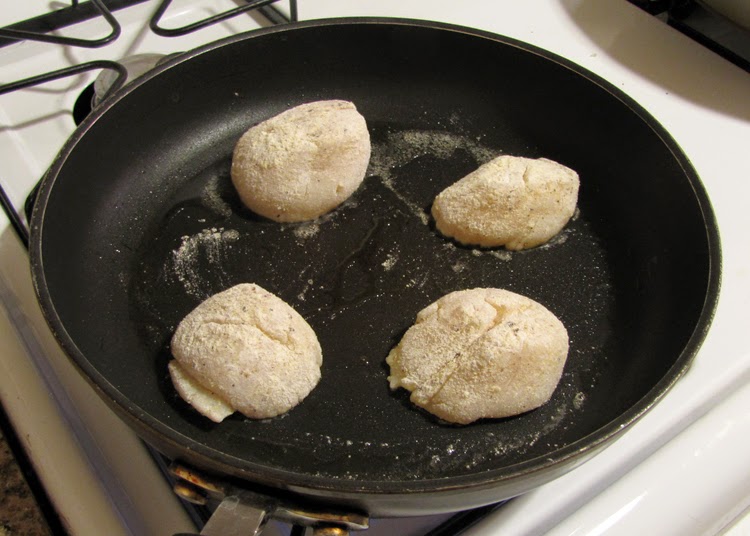
Sprinkle scallops with remaining 1/4 teaspoon salt and pepper; toss scallops in flour mixture to coat.


Heat medium skillet over medium-high heat until hot. Add oil; heat until hot.


Add scallops, in batches if necessary; cook 3 to 4 minutes or until light brown and center is barely opaque, turning once.


Serve scallops with corn relish.


TIP *If corn is very sweet, omit sugar from recipe.


My first time doing scallops and I'm impressed! They turned out perfectly, tender and moist with just-crisped, caramelized exteriors, and opaque interiors, and loaded with flavor.

The vinegar in the relish became wearisome very quickly as it is quite a pungent flavor. I'd ease up on that quite a bit and/or have a milder flavored side dish to accompany. The scallops should be the star here, but the relish is just too in-my-face. Eating dinner, I'm thinking anything else would be good. Broccoli, French fries, cole slaw. Maybe that's a sign that I should have prepared a side to accompany.

Cost:
  • red bell pepper: $0.92
  • onion: $0.21
  • cider vinegar: $0.08
  • sugar: $0.03
  • ears of corn: $0.78
  • cornmeal: $0.03
  • jumbo sea scallops: $18.16
  • olive oil: $0.06
Total: $22.27 or about $10.14 for each of two servings.