Pages

Sunday, March 4, 2012

Cheesy Artichokes, Cauliflower and Red Pepper


Artichoke hearts and cauliflower baked with a cheesy sauce...I imagined it'd be like a broccoli and cheese sort of casserole and that it'd be delicious. Plus it sounded like it would go well with the chicken breast dish I was planning on trying.

Cheesy Artichokes, Cauliflower and Red Pepper
adapted from Cooking Club of America
click to print

4 c cauliflower florets (12 oz.)
1 (14-oz.) can quartered artichokes, drained, patted dry, chopped
2/3 c chopped red bell pepper
1/3 c sliced green onions
1 1/2 tbsp butter
1 small garlic clove, minced
1 1/2 tbsp all-purpose flour
3/4 c milk
1/4 tsp salt
1/8 tsp pepper
1/2 c shredded Gruyère cheese
1/4 c shredded Parmesan cheese

Heat oven to 400°F. Spray a 7x11" baking dish with cooking spray.

Place cauliflower in large microwave-safe bowl; add enough water to come 1/2 inch up sides of bowl. Cover; microwave on high 2 to 3 minutes or until still crisp but starting to soften.


Drain; rinse under cold water to cool. Pat dry or allow to dry on a towel.


Meanwhile, melt butter in medium saucepan over medium heat. Cook and stir garlic 30 seconds or until fragrant.


Whisk in flour; cook 1 minute, whisking constantly.


Pour in milk, whisking constantly.

That whisking constantly part means I need my camera hand to serve as my whisking hand.

Bring to a boil, whisking until smooth; add salt and pepper. Boil 1 minute; stir in Gruyére cheese until melted.


Toss cauliflower, artichokes, bell pepper and green onions in large bowl.


Pour hot sauce over vegetables; stir gently to coat.


Spoon vegetables into baking dish; sprinkle with Parmesan cheese. (Vegetable mixture can be made to this point 8 hours ahead. Cover and refrigerate.)
 

Bake 35 to 40 minutes or until lightly browned and bubbling.


I was right! This is good! The sauce didn't make the vegetables a wet mess yet it wasn't over the top with cheese. The cauliflower was still firm though tender -- no mush! Artichoke hearts, well, they are soft out of the can anyway but you can forgive them for that since they taste so good. I wondered if the artichokes coupled with cheese would be really salty, but the bland cauliflower balanced it very well. Bell peppers add a little pizzazz and colorful sparkle. It's a keeper! If you prepare meals for the holidays, maybe keep this in mind since it does allow for prep eight hours in advance of baking.

The recipe as written originally has you patting the microwaved cauliflower dry, mixing with the other vegetables and then making the sauce. I much preferred my air dry on towel, make the sauce, and then mix the vegetables method. It saves a few minutes and some hassle. Patting cauliflower dry isn't what I call exciting, so why do it if unnecessary? If you're really worried about extra water, you could roll the cauliflower up in towels for maximum absorption.

Cost:
  • cauliflower: $1.67
  • artichoke hearts: $2.69
  • red bell pepper: $0.91
  • green onions: $0.20
  • butter: $0.07
  • garlic: $0.10
  • milk: $0.37
  • Gruyere: $1.31
  • Parmesan: $0.67

Total: $7.99 or about $1 for each of eight servings. Really, I'll probably get six servings out of it, making them $1.33 each.


Von Muehlenen Classic Gruyere Cheese


I've joked before about how you'd wind up with multiple pounds of cheese if you bought it from Costco but that's not true. You can buy Von Muhlenen Classic Gruyere just one pound at a time.


Out of the package, I cut the cheese into two pieces and trimmed the rind from the smaller piece. It's the first time I'll be trying a Swiss Gruyere. The two I've tried, Grand Cru and Boar's Head, are American.  


Trying the rind, it's really dry.


The cheese is delicious. Smooth, creamy, and nutty. I love how partly skimmed raw cow milk, animal rennet, bacterial cultures, and salt can come together and make cheese.


Here's a couple words on Gruyere from the Larousse Gastronomique I found interesting:
A Swiss or French cows'-milk cheese (45% fat content) with a firm but pliable texture and a brushed and washed rind. It takes about six months to mature in a damp cellar, and has a nutty flavour. It is ivory yellow or golden brown in colour.
Gruyere cheese is made in rounds weighing 35-45 kg (66-100 lb), 50-65 cm (20-26 in) in diameter and about 11 cm (4 in) thick.
According to the Swiss, Gruyere cheese is named after the Counts of Gruyere, whose coat of arms was embellished with a crane (grue) and who settled in the Gruyere valley in the canton of Fribourg at the beginning of the 9th century (in France, Swiss Gruyere is called 'Fribourg').
 Von Muehlenen Classic Gruyere Cheese available in one pound portions for $10.49/lb at Costco.


Artichoke Hearts

I don't use artichoke hearts very often, but when I do I get them in a jar. Or in a can like these.

The label is sort of misleading. It doesn't say artichoke heart quarters. The ingredient statement is clear though.

And just now I see where the artichoke hearts are from! Spain!

The citric acid in the ingredients is to keep these babies from going brown.


If you're interested, here's the nutrition facts. And yep, they are pretty salty, though very tasty.


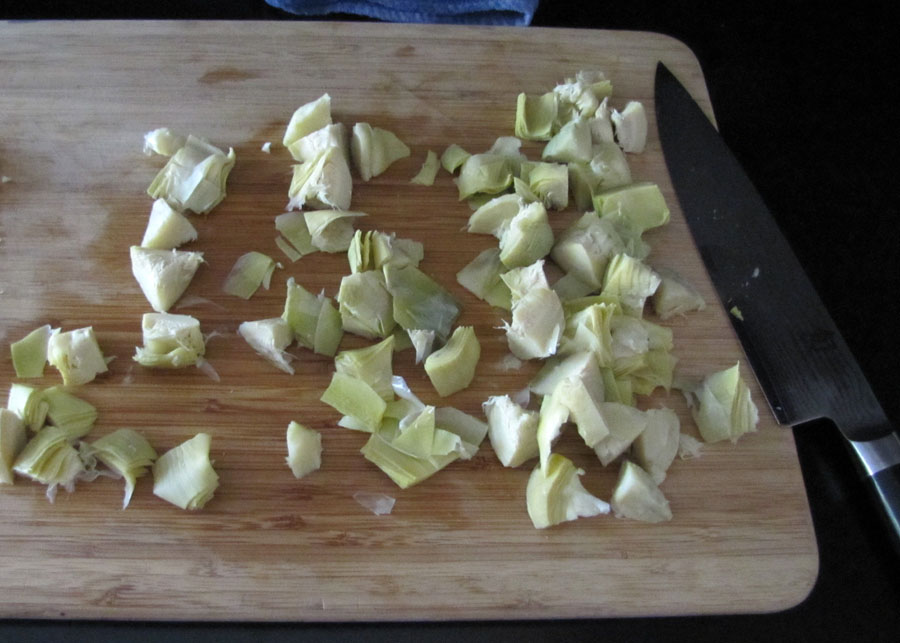
The recipe I'm going to try next calls for these hearts to be drained, patted dry, and chopped. I did it like this.
Whoa, crazy contrast.


Artichoke hearts available in a 13.75 oz can for $2.69 in the canned vegetable aisle of Stater Bros.


Saturday, March 3, 2012

Debone a Chicken a la Pepin Gallantine Ballotine

It's no secret that I prefer to purchase whole chickens and cut from them the pieces I need. It's much less expensive, but what I like best is that the pieces are cut the way I want them, not the way it's easiest for the Chicken Company/Processor to get them out the door.

Early February I'd picked up some chicken leg quarters and used the thighs for the Chicken Fricassee. I didn't rant and rave about it, but the fact that the chicken was sawed down the middle resulting in backbone (and yes, oysters) adding to the weight and that none of the excess fat or skin was trimmed was a burr under my saddle. Paying a higher price for specific pieces left me paying higher price for the stuff I would've cut off. Half the mass was junk (I don't know yet what to do with chicken skin).

So that leaves me obsessed with better processing of the birds in my kitchen. I gave it a try: deboning a chicken like Pepin does in this video. I kept the legs intact though since I have a plan for those and the bones are necessary. Besides, I already know how to bone out thighs; it's just a matter of getting quicker.


The whole chicken was removed from packaging, the giblets and neck removed from the cavity, the body and cavity rinsed with cool water before drying well with paper towel.


The wings were removed from the body at the second joint, leaving the drumettes attached to the body. The removed flatwing and wingtip sections were set aside.


The skin at the neck was pulled back a little bit. Feeling around in the flesh opposite the neck bone, I identified where the wishbone was and cut along both sides of the wishbone before wrestling the it out intact.


The chicken was flipped so the breast side was down and the back was facing me. I sliced along the backbone before turning the bird on a side, pulling the skin up to find the articulation of the wing joint. I sliced through the joint, freeing the drumette.


And then I did the same thing on the other side.


Grabbing the drumettes one at a time, I pulled them out from the body and then down along the body until I could see the oysters at the thighs.


Flipping the bird so the breast side was facing me, I could see that the tenderloins were fully exposed.


Grasping the entire mass of breast flesh, I pulled it down past the tip of the breast/keel bone.


Turning the bird back over so the breast side was down and the back side up, I cut out an oyster.


The thigh joint was popped out of the socket and the articulate material cut through freeing the entire leg from the frame though connected via skin. And then I did the other side.


The breast and legs were pulled from the frame, all of the skin going with the meat. Turning the meat inside out, skin-side up, the bird looked like it had been butterflied and deflated.


Just as Pepin said, it was easy work to slide a thumb under the tenderloins on each side of the keel and freeing them.


The drumettes were removed and the bird quartered yielding two whole legs (aka Marylands) and two breast halves. The skin was removed from the boneless breasts in anticipation of a recipe.


The flatwing and wingtip sections I'd set aside earlier were separated. I bagged the drumette and flatwing portions to make a wings recipe later. The skin from the bird was disposed of. The rest, wingtips and frame, was bagged for stock.

While it took me many more minutes than Pepin (my 40 vs his 3) to accomplish this, the work itself was pretty easy. Of course, Pepin didn't stop to wash his hands after every step to take a photo, then review a video before proceeding. Instead he casually took care of that bird while slowing to discuss and point out key details. I would call Pepin a stud, but he deserves more respect than that. I plan to use this technique regularly in the future and of course, I'll get it down to three minutes.

The trickiest part was after the breasts are pulled down from the frame since it was a little hairy keeping track of what was what. Having that loose mass of breast/drumette flesh flopping around was definitely odd. Surprisingly, the breast meat stuck to the skin while I worked; I was sort of wondering if the membrane between meat and skin would gradually give way as I wrestled and flipped the bird.

It should be noted that when you cut through the joint dividing the drumette and body, care should be taken where you're cutting. If you cut into the breast, it might tear when you use the drumette as a handle to peel the breast from the frame. If done correctly, the breast halves peel away fully intact, which results in beautiful pieces.

Overall, I'm delighted with the way this worked out. I look forward to doing it again.


Food Plan and Grocery List, 030312

I ate chili three times last week and hambone soup once; I've got my fill of the soups for now. And while I should've utilized the frozen meat in my freezer, I couldn't get Pepin's deboning a chicken out of my mind. I have to do it. So I looked for chicken recipes and suitable sides to accompany.

Chicken with Tomato-Shiitake Mushroom Sauce
Alabama BBQ Chicken
Golden Roasted New Potatoes
Cheesy Artichokes, Cauliflower and Red Pepper

Costco:
  • unsalted butter: $6.69/4 lbs
  • gruyere cheese: $10.48
  • smoked paprika: $3.59
  • TOTAL: $20.76
Grower's Direct:
  • fresh-cut pineapple: $1.81/2.29 lb
  • green seedless grapes: $3.46/1.74 lb
  • green onions: $0.39/bunch
  • red bell pepper: $0.91/0.61 lb
  • cauliflower: $1.67/2.11 lb
  • shiitake mushrooms: $1.40/0.28 lb
  • baby red potatoes: $2.79
  • cage free eggs: $3.49/dozen
  • TOTAL: $15.92
Stater Bros.:
  • Alta Dena 2% milk: $0.99/pint
  • Haagen-Dazs raspberry sorbet: $3.99/pint
  • Dr. Pepper: $1.89/2 L
  • Stater Bros olive oil: $7.99
  • Stater Bros artichoke hearts: $2.69/13.75 oz
  • La Brea french baguette: $1.99/loaf
  • Foster Farms chicken: $6.09
  • TOTAL: $25.78
Grand Total: $62.46
Total for the year: $426.01


Friday, March 2, 2012

Cost of Take-Out Lunch, 030212

Monday: Island's on a coworker
Tuesday: Dairy Queen Iron Grilled Turkey Club Combo on a coworker
Wednesday: Subway Italian BMT on 6" wheat: $4.25
Thursday: Dairy Queen combo #2: $6.89
Friday: Sushi Plantation: $18.06

Total: $29.20
Total for the year: $355.31